
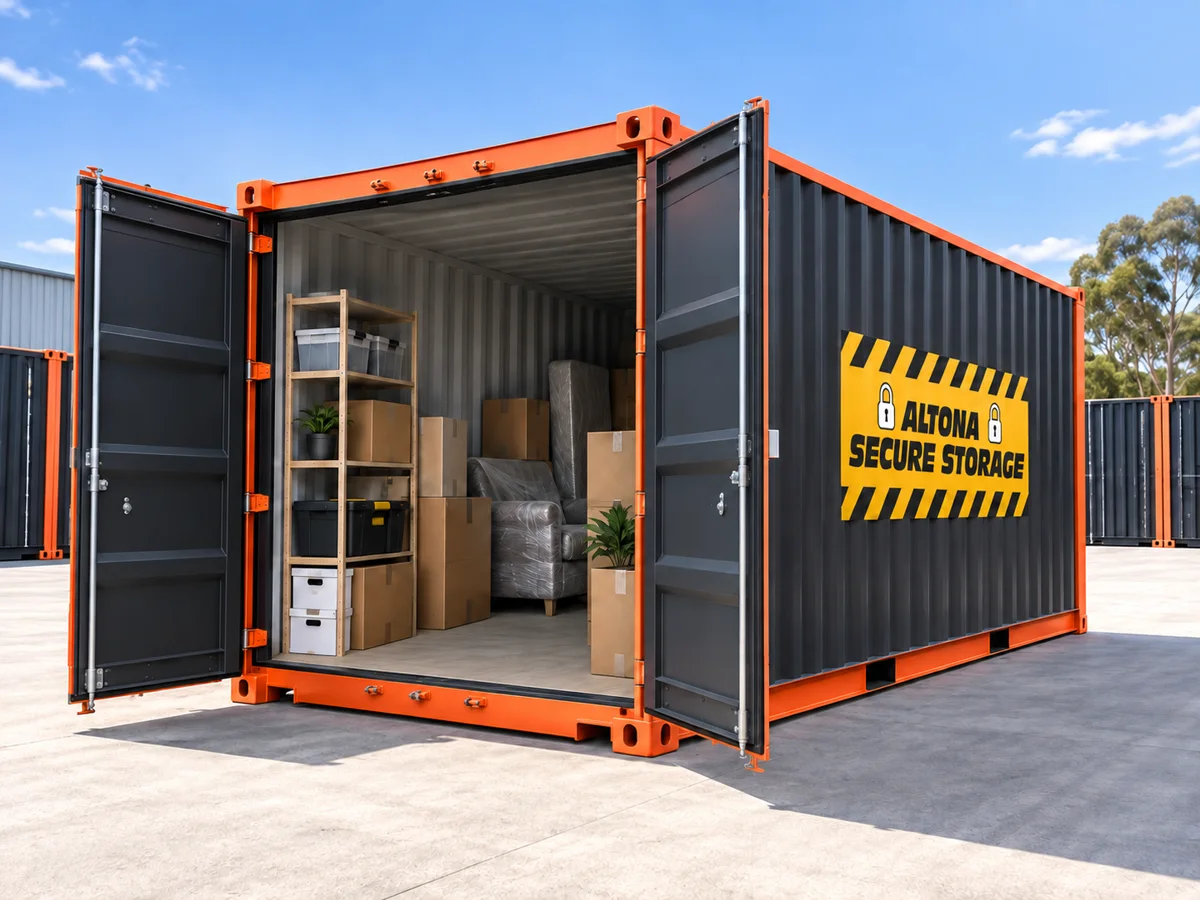
Container storage and traditional self storage solve the same basic problem: you need more room, but you do not want to part with the things taking up that room. The better option depends on what you are storing, how you plan to load it and how often you will need access.
What is the difference between container storage and self storage?
Traditional self storage commonly places individual units inside a larger building. Customers may move belongings through shared corridors, lifts or loading areas before reaching their unit. Unit sizes can vary considerably, which may be useful for people with a very small or unusually sized load.
Container storage uses a private steel shipping container as the storage space. The container is positioned at ground level, so the route between your vehicle and the doors can be simpler than navigating an internal building. At Altona Secure Storage, customers can choose between 10ft and 20ft weather-resistant steel containers at our facility in Altona.
Neither format is automatically right for everyone. The most useful comparison is not the name on the facility—it is how each option fits your belongings, access needs and moving plan.
Container storage vs self storage at a glance
| Consideration | Container storage | Traditional self storage |
|---|---|---|
| Loading route | Ground-level access can reduce corridors, lifts and repeated handling | May involve an internal loading bay, hallway or lift |
| Space | Large, rectangular space suited to mixed household or business loads | Often available in a wider range of smaller unit sizes |
| Organisation | Room for zones, shelving and an access aisle when planned well | Smaller units may suit a limited number of boxes or compact belongings |
| Typical uses | Moves, renovations, furniture, stock, tools and bulky equipment | Small personal loads, archive boxes or items needing a particular unit type |
| Weather protection | Steel containers are designed to help shield contents from the elements | Indoor units are protected by the surrounding building |
| Best value test | Whether the capacity and simpler loading process suit the total load | Whether a smaller unit closely matches the amount being stored |
Access arrangements, permitted items, insurance requirements and site features vary between facilities. Confirm the practical details with the storage provider instead of relying on the storage format alone.
When container storage can be the practical choice
Moving house or preparing a property for sale
A house move rarely happens in one perfectly timed step. Settlement dates may not line up, a new home may need work, or decluttering may begin weeks before removal day. A storage container provides one large space for furniture, cartons and household overflow while the transition is underway.
Ground-level loading is particularly helpful for bulky pieces. Sofas, mattresses, tables and appliances can be moved into the container without negotiating narrow internal corridors. Before move-in, follow our guide to preparing furniture and belongings for container storage so everything is clean, dry and protected.
Renovating without working around your furniture
Renovations create dust, restricted walkways and a constant need to shift belongings from one room to another. Moving furniture and boxed contents into dedicated storage can give trades clearer access and reduce the chance of accidental damage. A 10ft container may suit a focused room-by-room project, while a 20ft container can accommodate furniture from several rooms.
Business stock, tools and equipment
For businesses, storage needs are often less uniform than a set of household boxes. Stock, trade equipment, marketing materials, spare furniture and project supplies all use space differently. A rectangular container makes it easier to create labelled zones and keep fast-moving items near the doors.
If staff will access items regularly, plan for an aisle rather than filling every gap. Our business container storage guide explains how to set up zones, labels and a simple inventory system.
Large or awkward belongings
Bulky items can determine the storage layout even when the total load is modest. Measure long furniture, workbenches, shelving and equipment first. The full-height doors and open rectangular interior of a container can make it easier to position awkward pieces safely.
The largest items, the need for a walkway and the frequency of access often matter more than a rough box count. A little spare room can make the storage space far easier to use.
When a traditional self storage unit may suit
A traditional unit may be a sensible option when you only have a small number of boxes and can select a unit that closely matches the load. Some facilities also offer specialised storage environments or a broad range of small unit sizes. Those features may matter more than having one large ground-level space.
Consider a traditional unit when:
- Your entire load is compact and would leave most of a container unused
- You need a specialised environment that a standard steel container does not provide
- The facility's location or access schedule is significantly more convenient for you
- You only need to retrieve a few small items at a time
Compare the full arrangement rather than the advertised unit size alone. Loading distance, lift access, opening times, fees and the amount of usable space can all affect the real convenience of the service.
What should you check before booking storage?
The word “secure” should lead to practical questions. Ask how the site is monitored, how access is managed, what type of lock you need and who can enter the facility. You should also understand the provider's process for arranging visits and reporting a concern.
Before choosing any storage facility, confirm:
- The site's access and monitoring arrangements
- The lock requirements for your individual unit or container
- When and how you can access your belongings
- Which items are prohibited or need prior approval
- Whether your current insurance covers goods in storage
- How notice periods, payments and move-out arrangements work
Store belongings clean and completely dry, use sturdy cartons and keep irreplaceable documents or sensitive items somewhere more appropriate. Good packing and an accurate inventory remain important regardless of the storage format.
Choosing between a 10ft and 20ft container
Altona Secure Storage keeps the size choice straightforward. A 10ft container provides approximately 15m³ of capacity and suits smaller household loads, tools, seasonal belongings or focused business overflow. A 20ft container provides approximately 33m³ and is the more versatile option for moves, furniture, mixed stock and larger equipment.
The right size depends on usable layout as well as volume. Read our detailed 10ft versus 20ft container comparison before deciding, or tell our team what you plan to store and we can help you compare the available options.
Six questions that make the decision easier
- How much are you storing? Create a basic inventory and measure the largest pieces.
- How difficult will loading be? Consider the distance, doors, corridors, stairs and lifts between your vehicle and the storage space.
- How often will you visit? Regular access requires an organised layout and convenient arrangements.
- Will the load grow? Moves, renovations and business projects often create extra items after storage begins.
- Do any items need specialised conditions? Confirm suitability before assuming a standard storage space is appropriate.
- Which location reduces the real effort? A practical facility close to home, work or your moving route can save repeated travel.
Secure container storage in Altona
Altona Secure Storage provides monitored, ground-level 10ft and 20ft container storage at 7 Reserve Court, Altona. Our location serves households, trades and businesses across Hobsons Bay, Wyndham and Brimbank, including Williamstown, Point Cook, Werribee and Sunshine.
Explore all of our secure storage service areas, call 0467 099 381 or request container availability online. Tell us what you need to store, when you would like to move in and whether you expect regular access.